Predict Future Demand
Sigma Revenue sees what's coming before it happens and takes action
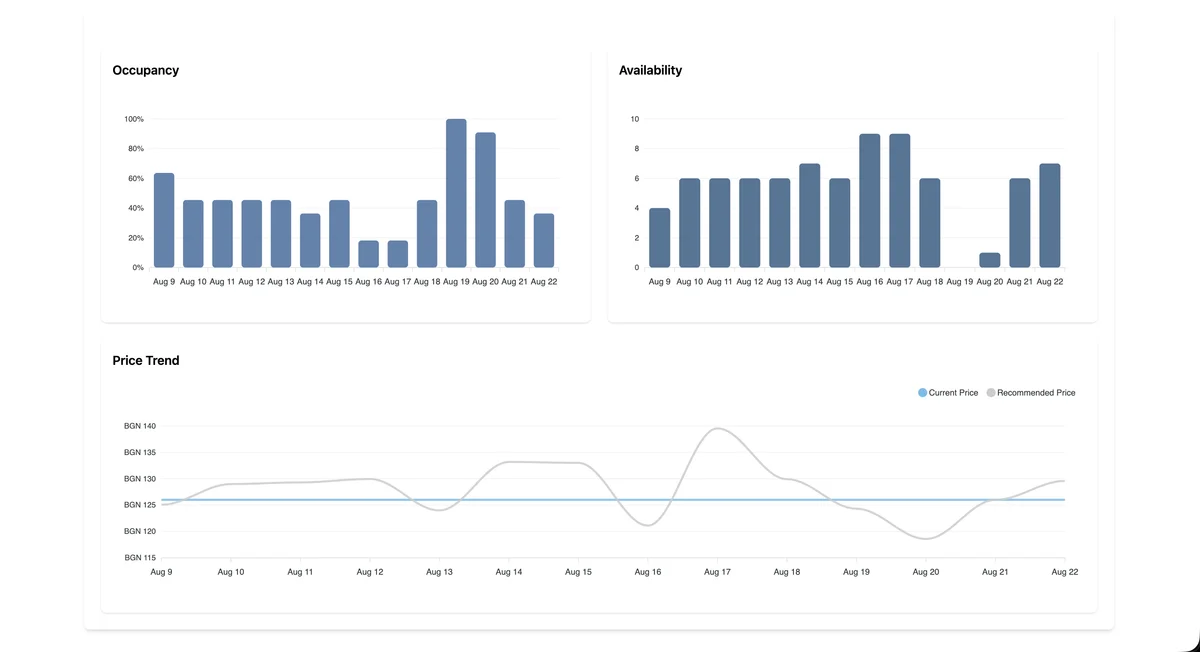
Stay ahead of the curve with intelligent demand forecasting
Forecast insights feed directly into rate recommendations and Autopilot, keeping your pricing aligned with real-time market conditions.
- Future insights
- Our software forecasts future occupancy based on historical data, live pickup, seasonal trends, and competitor behaviour.
- Pattern comparison
- Instantly compares current pickup patterns with previous years or forecasted targets to identify gaps or spikes in demand.
- Timely reaction
- Forecast data feeds directly into rate recommendations, ensuring your pricing stays ahead of demand.
- Machine learning
- Continuously updates and adapts as new data flows in, so the model improves over time.
How Sigma Revenue Works
Synchronise
Integrate with your existing PMS, channel manager, and distribution channels in minutes.
Analyse
Our software analyses historical, real-time, and competitor data.
Optimise
Get actionable rate recommendations for a whole year in advance to maximise your revenue potential.
Related Terms
Booking Pace
The speed at which reservations accumulate for a specific future date compared to the same point in time for similar historical dates. Tracking pace helps identify whether demand is building faster or slower than expected, enabling proactive rate adjustments. A date pacing ahead of last year may warrant a rate increase; pacing behind suggests promotional action.
Learn more →Booking WindowBooking Window / Lead Time
The number of days between when a reservation is made and the guest's arrival date. Understanding booking windows by segment is crucial—business travelers typically book 7-14 days out, while leisure guests may book 30-90 days ahead. This knowledge helps optimise when to release inventory and adjust pricing as the arrival date approaches.
Learn more →Constrained Demand
The actual number of rooms you can sell given real-world limitations—your physical inventory, existing bookings, and any restrictions you've applied (closed dates, minimum stays). Constrained demand represents what will actually happen, as opposed to unconstrained demand which shows total market interest. The gap between them reveals missed revenue opportunities.
Learn more →Forecast Accuracy
A measure of how closely your demand predictions match actual results, typically reported as a percentage error (e.g., an average error of 5%) or as an accuracy percentage. High forecast accuracy enables better pricing decisions, optimal staffing, and reduced operational waste. Track accuracy at multiple lead times (7, 14, 30 days out) to identify where predictions need improvement.
Learn more →OTBOn-the-Books
All confirmed reservations and their associated revenue for future dates—your guaranteed baseline before any new bookings come in. OTB is the starting point for all forecasting: you add expected future pickup to OTB to predict final occupancy. Monitoring OTB daily reveals whether you're building toward budget or falling behind.
Learn more →PickupPickup / Booking Pickup
The number of new room nights booked for a specific future date during a defined period (daily, weekly). Pickup is the key indicator of booking momentum—strong pickup suggests rates could increase; weak pickup may require promotional action. Comparing current pickup to historical patterns reveals whether demand is trending above or below expectations.
Learn more →Unconstrained Demand
A theoretical forecast of total demand if your hotel had unlimited inventory and no restrictions—how many rooms you could sell if capacity weren't a factor. Understanding unconstrained demand reveals the true size of your market opportunity. When unconstrained demand significantly exceeds available rooms, it signals opportunity to increase rates; when it's below capacity, promotional strategies may be needed.
Learn more →Related Articles
A Beginner’s Guide to Hotel Demand Forecasting
The signals that matter (pickup, lead time, seasonality) and how to turn them into better pricing decisions—especially when using dynamic pricing.
Read more →How to Read Booking Pace (Pickup) and Use It for Better Pricing
A step-by-step workflow to turn pace reports into pricing actions: build a baseline, validate signals, and apply dynamic pricing with confidence.
Read more →Booking Window Trends: What Shorter Lead Times Mean for Pricing
How to analyse booking windows by segment and channel—and how to adapt your dynamic pricing cadence and stay controls when guests book later.
Read more →Ready to get started with Sigma Revenue?
Let's discuss how Sigma Revenue can help you optimise your hotel's revenue management.